When first announced in Feb 2016 the proposed import regulation reforms sounded very positive — not only for motoring enthusiasts but for all Australians.
[dt_gap height=”10″ /]
AND a long time coming.
[dt_gap height=”10″ /]
The Need for Import Regulation Reforms
The current import regulations are restrictive to trade and lead to much higher prices on new cars by maintaining a monopoly situation and forcing consumers to buy from a car dealer within Australia.
[dt_gap height=”10″ /]
The prospect of losing their protected market and inflated profit margins sent Australian new car dealers into a spin when reforms were first proposed.
[dt_gap height=”10″ /]
Since then they’ve done everything they can to stop any changes, including:
claims that their own product sold in other countries would be unsafe in Australia
refusing to honour international factory recalls
refusing to service or supply parts for vehicles not sold through them
[dt_gap height=”10″ /]
Opportunities for Dealers and all Australians
To see the opportunities provided and the new jobs and markets that would be created, you need only look at how Toyota dealers in New Zealand have responded positively to deregulation of their market.
[dt_gap height=”10″ /]
The below video shows how Toyota NZ’s Signature Class system works for secondhand vehicle imports:
[dt_gap height=”10″ /]
[dt_gap height=”10″ /]
Allowing direct vehicle imports would also create a large number of new jobs in the import, parts, servicing and support sectors.
[dt_gap height=”10″ /]
Our opinion is that these jobs would far exceed those lost with the long drawn out departure of the financially nonviable vehicle manufacturing sector from Australia.
[dt_gap height=”10″ /]
Creating new employment and business opportunities by recognising the commercial reality of the situation forms a natural and sensible response to a changing world, and is the role of a good Government.
[dt_gap height=”10″ /]
Why hasn’t anything happened to change these unfair regulations until now ?
The Govt. has not acted due to scaremongering / lobbying by dealers and pressure from the heavily-subsidised vehicle manufacturing sector – a relatively small number of jobs but with a loud political voice.
[dt_gap height=”10″ /]
New car dealers stand to lose hundreds of millions of dollars per year if consumers were able to buy vehicles directly from the cheapest source.
[dt_gap height=”10″ /]
With this much to lose (and putting moral issues aside) it is clearly in their best business interest to spend millions on lobbyists to fight change.
[dt_gap height=”10″ /]
And since when do moral issues concern big business anyway ?
[dt_gap height=”10″ /]
So given the much smaller secondhand vehicle import industry, the situation is very much like David and Goliath.
[dt_gap height=”10″ /]
What is at Stake ?
Access to new and secondhand vehicles at the best international pricing makes obvious sense for the Australian consumer and aligns with the Govt’s desire for free trade.
[dt_gap height=”10″ /]
With free choice the consumer could then:
save money on the same vehicle
upgrade to a newer / better quality / more efficient vehicle for the same or lower price
spend more to obtain hybrids or other models not previously available
[dt_gap height=”5″ /]
The Effect ?
With vehicles costing less and a proportion of buyers naturally choosing to upgrade, there would be a significant improvement on safety and the environment.
[dt_gap height=”10″ /]
The most unsafe and inefficient vehicles would be progressively removed from Australian roads.
[dt_gap height=”10″ /]
The average age of the Australian vehicle fleet would be reduced.
[dt_gap height=”10″ /]
This would in turn lead to a reduction of deaths and injuries on Australian roads.
[dt_gap height=”10″ /]
These are all outcomes the Govt. has said they want, as of course would any reasonable person with a genuine interest in the welfare of Australians.
[dt_gap height=”10″ /]
All these things WOULD happen with a deregulated and independently monitored industry.
[dt_gap height=”10″ /]
What the Experts Say
A Productivity Commission Report in 2014 and two other reports conducted for the Govt. in 2014 and 2015 have all supported the lifting of import restrictions.
[dt_gap height=”10″ /]
Australian Productivity Commission Report 2014
In March 2014 this concluded that allowing the direct personal import of vehicles by consumers would lead to lower vehicle prices and greater vehicle variety.
[dt_gap height=”10″ /]
The Report recommended lifting import restrictions.
[dt_gap height=”10″ /]
Castalia Report 2014
Castalia Advisory Group produced their first Govt. commissioned report in July 2014.
[dt_gap height=”10″ /]
Their analysis looked at the costs and benefits of deregulating the trade in used imported cars and showed significant net welfare gains between $805 million and $1,943 million over a 10 year period.
This second report in March 2015 focused on the effect of deregulating the trade in vehicles between 0 and 5 years old.
[dt_gap height=”10″ /]
It predicted significant net safety and environmental benefits over a ten year period of between $703 million for new vehicles and $1,166 million when de-regulating used imports up to the age of five years.
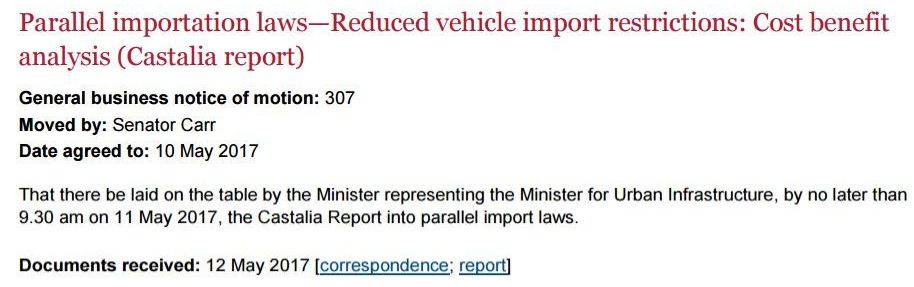
NOTE: The Govt. DID NOT RELEASE the Castalia Reports to the public.
The 2015 Report ONLY became available in May 2017 at the request of Senator Kim Carr:
[dt_gap height=”10″ /]
What are the latest official developments ?
NONE.
[dt_gap height=”10″ /]
There have been NO updates from the Govt. for the last 9 months on any of the proposed changes or transition periods.
[dt_gap height=”10″ /]
This puts jobs at risk as it leaves those in the secondhand vehicle import industry in a state of limbo, unable to make reasoned and informed business decisions and with an unknown future hanging over them.
[dt_gap height=”10″ /]
As with the introduction of SEVS in 2002, there has been no mention of compensation for those who have spent considerable time, money and years of their lives to jump through the hoops of the current scheme.
[dt_gap height=”10″ /]
They now face losing the bulk of their business at a moment’s notice when the Minister deigns to issue a Press Release, with no indication there will be advance warning.
[dt_gap height=”10″ /]
No warning, no compensation.
[dt_gap height=”10″ /]
This is particularly unfair given the time the Govt. has already taken to consider the changes.
[dt_gap height=”10″ /]
The industry has been contracting for many years, with requests for the Govt.’s help to revitalise import options and to reduce costs falling on deaf ears.
[dt_gap height=”10″ /]
The marked reduction in import numbers (now down to about 5,000 vehicles per year) has been due to natural changes in the pricing and availability of popular models and the fact that the import regulations have not kept pace with reality.
[dt_gap height=”10″ /]
We estimate that more than half of those people employed in the secondhand vehicle import industry in recent years have already lost their jobs or been forced to find other work.
[dt_gap height=”10″ /]
Against the best advice and without regard to the survival of the industry itself, since 2014 the Govt. has progressively reduced the scope of reforms being considered:
[dt_gap height=”10″ /]
2014 Full deregulation considered
2015 Back-step to allow vehicles up to 5 years old only
2016 Another back-step to allow new vehicles only
2017Complete backflip on what was promised ? We wait to see…
[dt_gap height=”10″ /]
Behind the Scenes
Dealers and online paid mouthpieces continue to spread shameless self-motivated propaganda against the changes rather than embracing the overwhelmingly positive impacts for Australian consumers and businesses, and the new opportunities it would open up for the dealers themselves (see NZ’s Signature Class system above).
[dt_gap height=”10″ /]
In the absence of official Govt. updates, the following is all we are able to currently surmise.
[dt_gap height=”10″ /]
General industry sentiment is that there is currently too much political inertia for the Govt. to pass import regulation changes in Parliament if they include the parallel import of new vehicles by individuals.
[dt_gap height=”10″ /]
In 2016 Minister Paul Fletcher unequivocally stated that this WOULD happen.
[dt_gap height=”10″ /]
So we believe this is the main issue the Govt. has been grappling with and why further updates have not been provided for so long.
[dt_gap height=”10″ /]
At the root of the problem — politicians that the Govt. needs to support the changes in order for them to become law are concerned they will lose their seats in the next election should they support the parallel import of new cars.
[dt_gap height=”10″ /]
They have formed this view based on a wholly negative campaign mounted by car dealers located in their electorates.
[dt_gap height=”10″ /]
On the “positive” side, there doesn’t seem to be any great opposition to an update to SEVS, however this is probably because the changes as they stand would eliminate 70% of the current import market by excluding people movers such as the Toyota Estima, Nissan Elgrand and Mitsubishi Delica.
[dt_gap height=”10″ /]
Alone, that could reduce total import numbers to 1,500 per year — and based on those figures about 70% of businesses in the industry would also face closure, putting those they employ out of work.
[dt_gap height=”10″ /]
While the proposed changes would allow more hybrids, electric and other vehicles to be imported under new environmental criteria, it is hard to say how many vehicles this would actually represent.
[dt_gap height=”10″ /]
Limited production run models would also be allowed however this would represent very few vehicles annually due to the rarity and high cost of these vehicles.
[dt_gap height=”10″ /]
Our current view is that the 25 Year Rule is likely to go ahead in some form.
[dt_gap height=”10″ /]
Whether this allows all cars based on age alone or whether additional restrictive criteria will be imposed on these vehicles will obviously have a great impact on whether this rule is actually viable and useful for enthusiasts.
[dt_gap height=”10″ /]
If it operates in a similar way to the current 1988 and older rule then it would be positive and allow a lot of desirable vehicles that have not before been available for import to Australia.
[dt_gap height=”10″ /]
So we await further detail with interest.
[dt_gap height=”10″ /]
Note that registration of vehicles imported under this 25 years and older option would still be handled differently by each State / Territory with regard to “compliance” type changes that need to be made.
[dt_gap height=”10″ /]
What can you do ?
The official stakeholder comment periods have ended so the Govt. no longer needs to go through the motions of listening to external views (industry or the public).
[dt_gap height=”10″ /]
It is still worthwhile to contact Minister Paul Fletcher to make your views known and demonstrate that keen community interest remains for positive change in this area.
[dt_gap height=”10″ /]
It may be more beneficial however to contact the following politicians with some influence behind the scenes in this matter, when it comes time to vote on the changes.
[dt_gap height=”10″ /]
Even better if you live in their electorate.
[dt_gap height=”10″ /]
For your views to be heard — always keep communication to the point and factual, listing any benefits clearly in dot form and include evidence where available.